Chocolate without mistakes: how to melt, temper and make ganache
Why a drop of water makes chocolate seize and how to rescue it, tempering temperatures for dark, milk and white, ganache ratios for glaze, truffles and whipped cream. The difference between natural and Dutch-process cocoa and where the white bloom comes from.
Which chocolate to use for desserts
Read the ingredients, not the label that says "dark". Real chocolate is cocoa mass, cocoa butter, sugar and sometimes lecithin and vanilla. If you see vegetable fats (palm, coconut, "cocoa butter equivalent"), it's compound coating: it can't be tempered, melts poorly and tastes waxy.
The cocoa percentage affects both flavour and the recipe. Dark chocolate of 55–70% suits most desserts. 80% and above gives a drier, denser texture and bitterness — don't swap it one-for-one into a recipe written for 60%.
How to melt chocolate
Chocolate doesn't like heat: dark starts to suffer above 50–55 °C, milk and white above 45 °C. Overheated chocolate turns thick, lumpy and dull, and white chocolate can scorch yellow.
- Bain-marie: a bowl over a pan of barely simmering water. The bowl mustn't touch the water and steam shouldn't escape round the sides. Stir with a silicone spatula.
- Microwave: 20–30 second bursts at medium power, stirring after each. Once two-thirds has melted, take it out and stir — the rest melts from the residual heat.
- In hot cream: pour hot cream over chopped chocolate, wait 1–2 minutes, then stir. That's how ganache is made.
Why chocolate seized and how to save it
A drop of water or steam in melted chocolate turns it instantly into a thick, grainy paste. It isn't burnt: the sugar and cocoa particles absorbed the moisture and clumped. The paradox is that chocolate happily takes a lot of liquid (as in ganache), but a little ruins it.
The fix: add more liquid. Stir in 1 tsp boiling water, hot cream or milk per 50 g of chocolate and beat hard. It will turn smooth again. It's no good for tempering or coating any more, but fine for sauce, ganache, brownies or hot chocolate.
Tempering: why it matters
Cocoa butter can set in six different crystal forms, and only one gives chocolate its gloss, snap and resistance to warm hands. Tempering is controlled cooling that produces exactly those crystals.
If you simply melt and chill chocolate, it will be dull, streaked grey, soft and will melt at a touch. Temper for coating sweets, decorations and bars. For ganache, brownies, cakes and sauces you don't need to.
The seeding method — easiest at home
You need a probe thermometer. The idea: melt part of the chocolate, destroying all its crystals, then add solid tempered chocolate that passes the right crystals on to the whole batch.
- Take 300 g chocolate. Melt 200 g and finely chop 100 g.
- Heat the melted part: dark to 45–50 °C, milk to 40–45 °C, white to 40 °C.
- Take it off the heat, add the chopped chocolate and stir until it has all melted and the temperature drops to working temperature.
- Working temperature: dark 31–32 °C, milk 29–30 °C, white 28–29 °C.
- Test: dip the tip of a knife or a strip of baking paper and leave at room temperature. Properly tempered chocolate sets glossy in 3–5 minutes.
Ganache: ratios for every job
Ganache is an emulsion of chocolate and cream. Change the ratio and you get anything from a pouring glaze to firm truffles. Use 33–35% cream. Bring it almost to the boil, pour over chopped chocolate, wait 2 minutes and stir with a spatula in small circles from the centre — that's where a glossy emulsion starts to form.
- Pouring glaze for cakes and drips: dark chocolate and cream 1:1 (100 g + 100 ml). Use at 32–35 °C.
- Firm ganache for truffles and fillings: 2:1 (200 g + 100 ml). Sets in the fridge in 2–3 hours.
- Whipped ganache for frosting: 1:2 (100 g + 200 ml). Chill overnight, then whip to soft peaks.
- Milk chocolate is softer — use half as much chocolate again: 1.5:1 for glaze, 3:1 for truffles.
- White chocolate is softer still: 2:1 for glaze, 3:1 for firm ganache.
Cocoa powder: natural and Dutch-process
Natural cocoa is light and slightly acidic. Dutch-process (alkalised) cocoa has been treated with alkali: it's darker, mellower and dissolves better.
It matters in baking: natural cocoa is acidic and reacts with baking soda to give lift. Dutch-process is neutral, so it needs baking powder. If a recipe uses only soda and you're using Dutch cocoa, add 1 tsp baking powder or the cake will be dense.
To bring out cocoa flavour, bloom it: mix it with hot water, coffee or melted butter before adding it to the batter.
White bloom on a bar
Grey or whitish bloom comes in two kinds. Fat bloom feels greasy and melts under a finger: cocoa butter has risen to the surface after temperature swings. Sugar bloom is dry and rough: moisture dissolved sugar on the surface and then evaporated.
Both are harmless. Such chocolate is perfect for baking, ganache and hot chocolate — the bloom disappears when melted. Store chocolate at 15–18 °C somewhere dark, wrapped, away from strong smells. The fridge isn't ideal: moisture condenses on the bar when it comes out into the warm.
Chocolate baking: fudgy or cakey
Brownie texture depends on the balance of fat, chocolate and flour. More chocolate and butter and less flour makes them moist and fudgy. More flour and raising agent makes them airy, like cake.
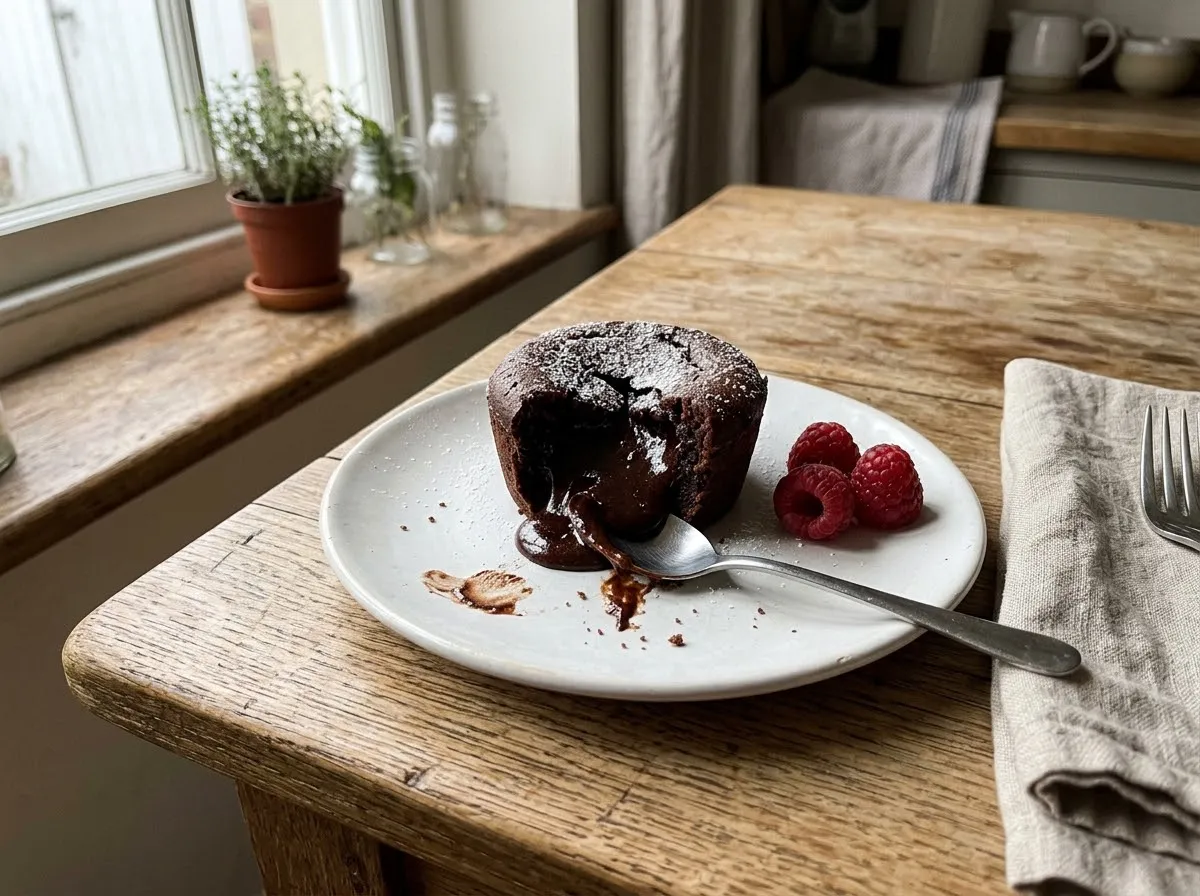
The main mistake is overbaking. Take brownies out when a toothpick from the centre comes out with moist crumbs but no wet batter: they finish setting as they cool. Take fondants out when the edges have set but the centre still wobbles — in a 100–150 ml ramekin at 200 °C that's 8–10 minutes.
The shiny crackly top comes from well-dissolved sugar: whisk the eggs and sugar for 3–5 minutes until pale and fluffy and mix them with warm, not cold, chocolate.
Questions and answers
Can I melt chocolate straight in a pan on the hob?+
Only together with cream or butter, over the lowest heat and stirring constantly. Plain chocolate over direct heat will almost certainly overheat on the bottom.
Why is my ganache greasy and split?+
The cream was too hot or there was too much chocolate for the volume. Add 1–2 tbsp warm milk and stir from the centre — the emulsion will come back.
Can I replace chocolate with cocoa powder?+
Roughly: 30 g dark chocolate ≈ 3 tbsp cocoa + 1 tbsp butter + 1 tbsp sugar. The swap doesn't work for ganache or coating.
How long does ganache keep?+
Up to a week in the fridge in a sealed container, up to 3 months frozen. Let it come to room temperature before using.
Why does white chocolate clump instead of melting?+
It overheated: it's full of milk powder, which scorches above 45 °C. Melt white chocolate in short 15-second bursts.
Try it in practice


More kitchen secrets
Sushi and rolls at home: restaurant-style rice, fillings and safe fish
Which rice to use and how to rinse it, the water ratio and seasoned vinegar, how to cool rice properly. How to roll maki and inside-out rolls that don't fall apart, which fish is safe raw, fillings without raw fish, baked rolls and storage.
Read the articleHow to assemble a cake at home: level layers, soaking syrup, smooth sides and drips
How to cut a sponge into even layers, how much soaking syrup each layer needs, why to pipe a dam and do a crumb coat, how to smooth a cake with a scraper, how much frosting a 20 cm cake needs, how to make chocolate drips, stack a tall cake and transport it in one piece.
Read the articleHomemade ice cream without a machine: rich vanilla, sorbet and banana ice cream
Two-ingredient ice cream with condensed milk, a classic custard-based vanilla, why ice crystals form and how to prevent them, sorbet with the right amount of sugar, frozen-banana ice cream, ice lollies and storage tips.
Read the article