A whole chicken: how to joint it, roast it with crisp skin and make stock from the leftovers
Why a whole chicken is better value than parts, jointing into 8 pieces in 5 minutes, roasting with a dry brine and crisp skin, spatchcock chicken, checking doneness by temperature, keeping the breast juicy, stock from the carcass and handling raw poultry safely.
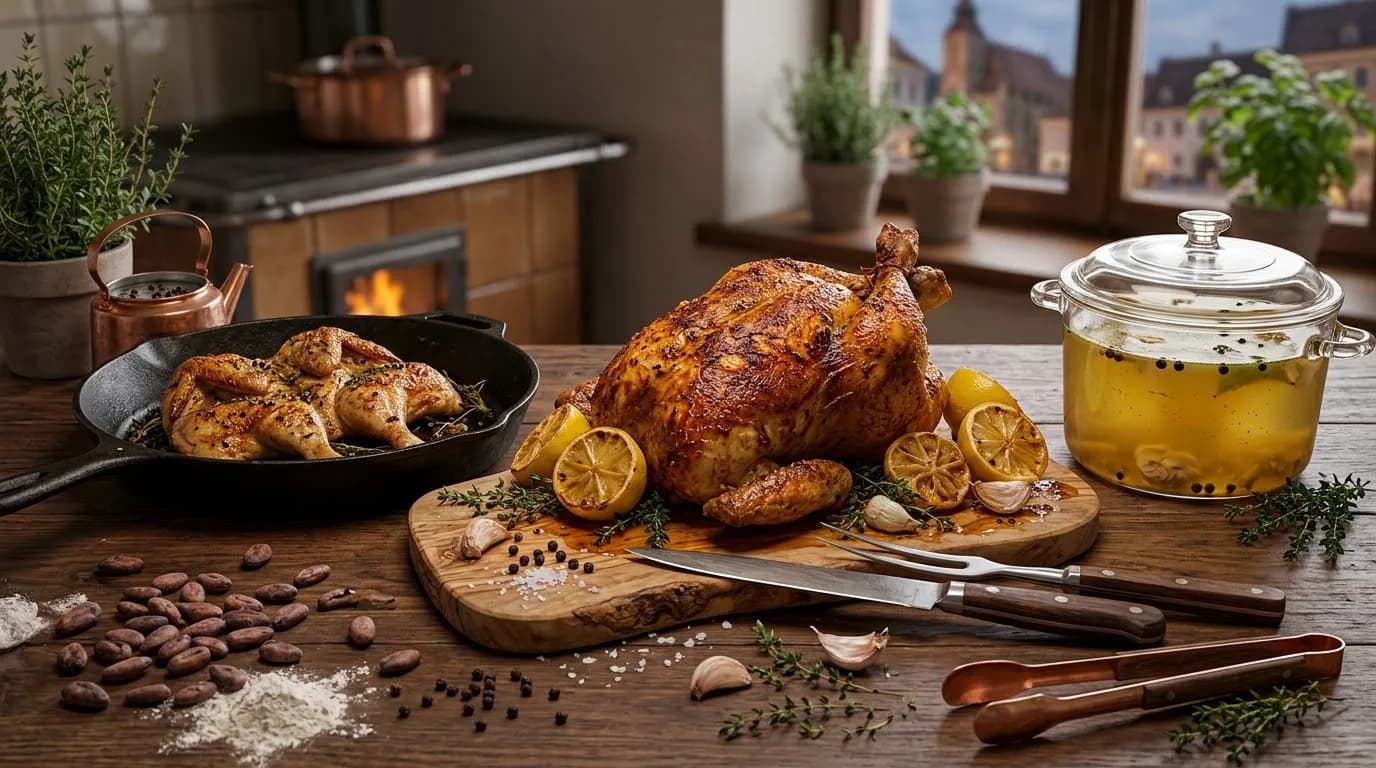
Why buy it whole
A kilo of whole chicken costs noticeably less than breasts or thighs bought separately. And one bird gives several meals: breast for dinner, legs for roasting, wings as a snack and the carcass for stock.
For roasting whole, choose a 1.4–1.8 kg bird: it cooks evenly, and the breast doesn't dry out while the legs finish cooking.
Safety
Don't wash raw chicken under the tap: the splashes spread bacteria half a metre around the sink and kitchen, and cooking kills them anyway. Just pat the bird dry with paper towels.
- A separate board for raw meat and poultry.
- Wash your hands, knife and board with hot soapy water straight after jointing.
- Thaw chicken in the fridge — it takes about a day per 2 kg.
- Doneness is about temperature, not colour: 74 °C in the thickest part of the thigh.
Jointing into 8 pieces
You need a sharp medium-length knife. Poultry shears make it easier but aren't essential.
- Legs: pull the leg away from the body, cut through the skin, pop the thigh out of its socket and cut it off along with the "oyster" on the back.
- Split the leg into thigh and drumstick along the line of fat at the joint — the knife goes through easily.
- Wings: pull the wing out, feel for the shoulder joint and cut through it.
- Breast: cut along both sides of the ribs to remove the back. Split the breast in half along the breastbone.
- Cut each breast half across again — you'll have 8 pieces of roughly equal size.
- Freeze the back, wing tips and trimmings for stock.
Dry brining — the secret to crisp skin
Rub the chicken with salt (1 tsp per 500 g) inside and out and leave it uncovered on a rack in the fridge for 12–24 hours. The salt penetrates the meat and makes it juicier, while the cold air dries the skin.
Dry skin is the key to crispness: wet skin steams in the oven first and only then starts to brown. If you're short on time, at least pat the chicken thoroughly dry and let it sit in the air for an hour.
Roasting whole
Take the chicken out of the fridge 30–40 minutes ahead. Rub the skin with butter or oil, put lemon, garlic and herbs inside and tie the legs with string.
Roast at 220 °C for the first 20 minutes, then lower to 190 °C and roast another 45–60 minutes. As a guide, about 40 minutes per kilo. Check with a thermometer in the thickest part of the thigh: 74 °C. Without one, pierce the thigh: the juices should run clear.
- Set the chicken on a rack or a bed of vegetables so the underside doesn't stew in its juices.
- Don't open the oven often: each time it loses 20–30 °C.
- Let the chicken rest for 10–15 minutes before carving so the juices settle.
Spatchcock: faster and more even
Cut out the backbone with shears, turn the bird breast up and press on the breastbone with your palm until it cracks. The chicken will lie flat.
A flattened chicken roasts at 220 °C in 40–45 minutes instead of an hour and a half, all the skin browns, and the breast and legs are done at the same time. The Georgian chicken tabaka is cooked the same way in a pan under a weight.
Keeping the breast juicy
The breast can come out at 68–70 °C — it climbs to a safe 72–74 °C while resting — whereas the thigh needs 74–80 °C to turn tender. So when roasting whole, the breast always risks drying out.
- Dry brining in advance is the most effective fix.
- Push herb butter under the breast skin.
- Cover the breast with foil if it's already brown but the legs aren't done.
- Roast breast side down for the first half of the time, then turn it over.
Stock from the carcass
The carcass of a roast or raw chicken makes excellent stock. Cover it with 2–2.5 l cold water, bring to the boil, skim the foam and simmer on the lowest heat for 2–3 hours without letting it bubble hard.
40 minutes before the end, add an onion, a carrot, parsley root or celery, peppercorns and a bay leaf. Strain, cool and lift off the fat. The stock keeps 4 days in the fridge and 3 months in the freezer.
Leftovers: what to make the next day
Pull leftover roast chicken off the bone while it's still warm — the meat comes away more easily. Keep it in the fridge for up to 3 days.
- Chicken salad with celery, apple and a yoghurt dressing.
- Noodle soup made with stock from the same carcass.
- Filling for wraps, tacos or pies.
- Fried rice or stir-fried noodles with vegetables.
Questions and answers
Why isn't my chicken skin crisp?+
The skin was wet, the temperature too low, or the chicken sat in its own juices. Dry it in advance, roast on a rack and start at 220 °C.
Can I roast a chicken from frozen?+
It's not recommended: the outside dries out before the middle heats through. Thaw it in the fridge.
Is pink meat near the bone raw?+
Not always. In young birds the meat near the bone can stay pinkish even when fully cooked. Check with a thermometer: 74 °C in the thigh.
How long does roast chicken keep?+
3–4 days in the fridge in a closed container. Boneless meat can be frozen for 3 months.
What should I rub on a chicken before roasting?+
The basics are salt, pepper, garlic and butter. Beyond that: paprika, thyme, rosemary, lemon zest, or mustard with honey.
More kitchen secrets
Courgettes and aubergines: no bitterness, no soaked-up oil and no watery mush
How to pick young ones, whether you really need to salt aubergines, why they soak up oil like a sponge and how to stop it, frying, roasting and grilling, courgette fritters that hold together, vegetable caviar and storage.
Read the article
Onions and garlic: cutting without tears, caramelising and not burning them
Which onion for what, why onions make you cry and what actually helps, fast dicing, sweating, browning and true caramelisation in 40 minutes, garlic — crush or slice and when to add it, pickled onions, roasted garlic and storage.
Read the article
Tomatoes: how to pick tasty ones, peel them, make sauce and dry them
Which tomatoes for salad, sauce and roasting, why tomatoes don't belong in the fridge, how to peel them in a minute, sauce from fresh and tinned tomatoes, roasted cherry tomatoes, oven-dried tomatoes and what to do with green ones.
Read the article