No-bake desserts: gelatine, agar, panna cotta and mousses that hold their shape
How much gelatine per litre for jelly, panna cotta and mousse, why gelatine must never boil and which fruits stop it setting. Agar instead of gelatine, stable whipped cream, a biscuit base for cheesecake and how to turn a dessert out cleanly.
Gelatine: sheets and powder
Gelatine comes in two forms. Sheets are easier: they're simpler to measure (a silver-grade sheet weighs about 2 g) and don't form lumps. Powder is cheaper and more widely available.
Any gelatine is soaked in cold water first. Powder in 5–6 parts water (10 g in 50–60 ml) for 10 minutes — it absorbs all the water and swells. Sheets in a bowl of plenty of iced water for 5–10 minutes, then squeezed out. Dissolve the bloomed gelatine in warm, not boiling, liquid.
How much gelatine you need
The dose depends on the result you want: a wobbly panna cotta or a jelly you can cut with a knife. Amounts are per 1 litre of liquid.
- Soft, wobbly texture (panna cotta, creams): 12–16 g.
- Classic jelly in glasses: 15–20 g.
- Mousse and soufflé: 16–20 g per 1 kg of mixture.
- Jelly to turn out and slice: 25–30 g.
- Cake layers: 20–25 g.
Fruits that stop jelly setting
Fresh pineapple, kiwi, papaya, mango, fig, melon and ginger contain enzymes that break down the protein in gelatine. Jelly with them won't set at all, however much gelatine you use.
The fix: bring these fruits to the boil for 1–2 minutes — the enzymes are destroyed. Or use canned fruit, which has already been heated. Or swap gelatine for agar — it's plant-based and the enzymes don't affect it.
Agar: the plant-based alternative
Agar is made from seaweed. It's 8–10 times stronger than gelatine and, unlike gelatine, must be boiled: it only dissolves after 1–2 minutes at a boil.
Agar sets at 35–40 °C, right on the counter, in 20–30 minutes. The jelly is firmer and slightly brittle rather than wobbly. On the plus side, it doesn't melt at room temperature.
- Soft jelly: 1 g agar per 500 ml liquid.
- Firm, sliceable jelly: 2 g per 500 ml.
- Replacing gelatine: roughly 1 g agar for 8–10 g gelatine.
- Stir the agar into cold liquid, bring to the boil and boil for 1–2 minutes, stirring.
Panna cotta
The classic Italian dessert: cream, sugar, vanilla and just enough gelatine that it barely holds its shape and melts in the mouth.
- 500 ml 33% cream (or 400 ml cream and 100 ml milk)
- 50–60 g sugar
- A vanilla pod or 1 tsp vanilla extract
- 6–8 g gelatine (6 g for glasses, 8 g to turn out onto a plate)
- Bloom the gelatine. Heat the cream with the sugar and vanilla almost to the boil, take off the heat and dissolve the squeezed gelatine in it. Strain, pour into moulds and chill for at least 4 hours.
Whipped cream that doesn't collapse
Whipping needs cream of 33–35% fat. 20% cream won't whip. Everything must be cold: cream, bowl and whisks — put them in the freezer for 10 minutes.
Whip on medium speed to soft peaks, then add icing sugar (30–40 g per 250 ml) and whip to firm peaks. Stop in time: overwhip and the cream turns into butter and whey.
Mousses
A mousse is a flavoured base with whipped cream or egg whites folded in. The main rule: fold the light into the heavy gently, with a spatula, in bottom-to-top strokes to keep the air.
Egg-free chocolate mousse: melt 150 g dark chocolate and cool it to 35–40 °C (warm, not hot). Whip 300 ml 33% cream to soft peaks. Fold a third of the cream into the chocolate first to loosen it, then the rest. Spoon into glasses and chill for 3 hours.
Berry mousse: 300 g berry purée, 60–80 g sugar, 10 g gelatine, 300 ml whipped cream. Dissolve the gelatine in the warm purée, cool until it starts to thicken and fold in the cream.
A biscuit base
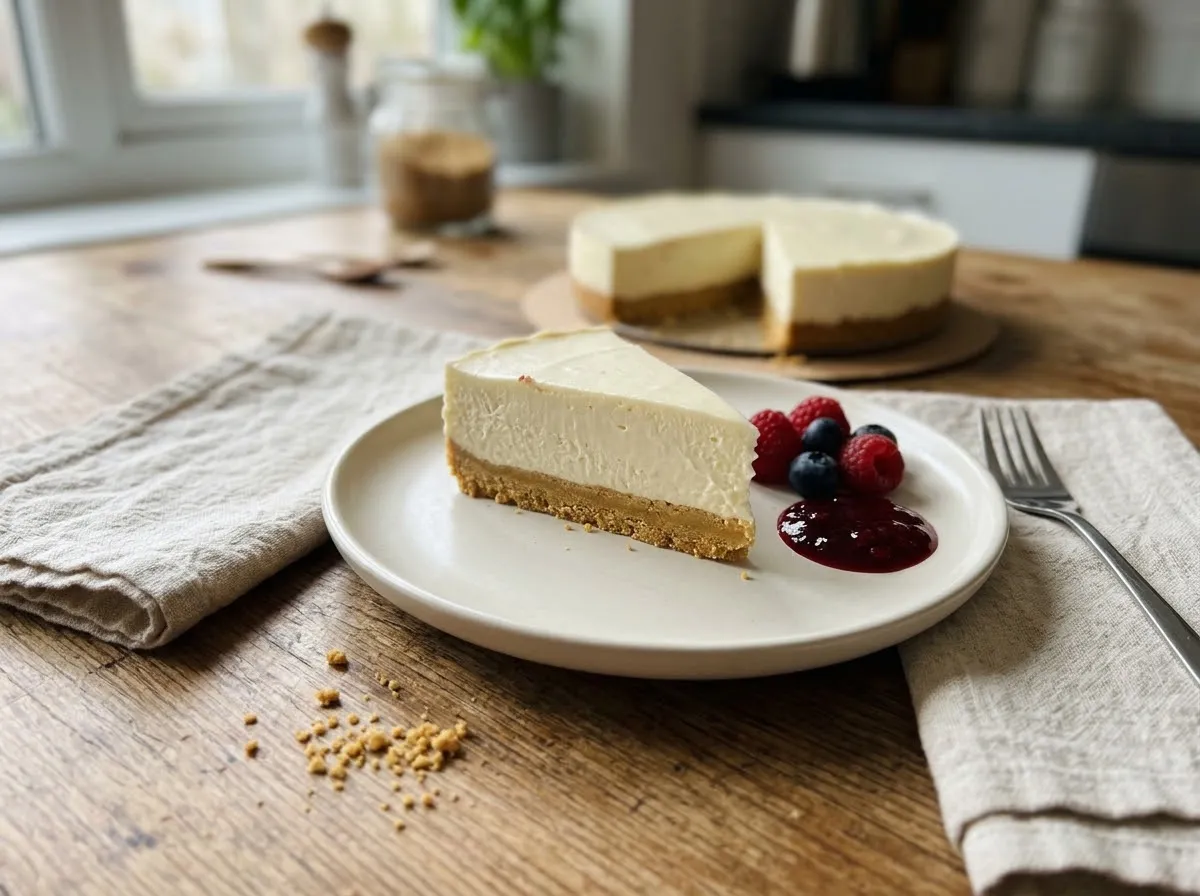
A base for no-bake cheesecake, tarts and slices: 200 g shortbread or digestive biscuits crushed to crumbs and 80–100 g melted butter. The mixture should hold together when squeezed in your fist.
Press the crumbs firmly into the tin with the base of a glass and chill for 30 minutes until the butter sets. For crunch, add 1 tbsp cocoa, a handful of ground nuts, or swap some of the biscuits for wafers.
Setting and serving
Gelatine desserts need at least 4 hours in the fridge, ideally overnight. Don't put them in the freezer to speed things up: the gelatine crystallises and the dessert turns watery once thawed.
To turn a dessert out, dip the mould in hot water for 5–10 seconds, run a thin knife round the edge, cover with a plate and invert. If it won't come, another 5 seconds in hot water. Silicone moulds simply peel away.
Make layered jellies in stages: pour each new layer once the previous one has set but is still tacky to the touch, and the new layer has cooled to room temperature. Otherwise the layers blend.
Questions and answers
Why didn't my jelly set?+
The gelatine boiled, there wasn't enough, or the jelly has fresh pineapple, kiwi or mango in it. Melt the jelly, add more bloomed gelatine (without boiling) and chill again.
Why is my jelly lumpy?+
The gelatine didn't bloom properly or went into cold liquid. Strain the liquid through a sieve before pouring into moulds.
Can I replace gelatine with starch?+
No: starch thickens but doesn't give a jelly structure. It works for custards and fruit kissel, not for jelly or panna cotta.
How long do gelatine desserts keep?+
2–3 days in the fridge, covered. With fresh cream and fruit, up to 2 days.
Why won't my cream whip?+
It isn't rich enough (under 30%) or it's warm. Chill everything, including the bowl and whisks. A cream stabiliser helps too.
Try it in practice


More kitchen secrets
Sushi and rolls at home: restaurant-style rice, fillings and safe fish
Which rice to use and how to rinse it, the water ratio and seasoned vinegar, how to cool rice properly. How to roll maki and inside-out rolls that don't fall apart, which fish is safe raw, fillings without raw fish, baked rolls and storage.
Read the articleHow to assemble a cake at home: level layers, soaking syrup, smooth sides and drips
How to cut a sponge into even layers, how much soaking syrup each layer needs, why to pipe a dam and do a crumb coat, how to smooth a cake with a scraper, how much frosting a 20 cm cake needs, how to make chocolate drips, stack a tall cake and transport it in one piece.
Read the articleHomemade ice cream without a machine: rich vanilla, sorbet and banana ice cream
Two-ingredient ice cream with condensed milk, a classic custard-based vanilla, why ice crystals form and how to prevent them, sorbet with the right amount of sugar, frozen-banana ice cream, ice lollies and storage tips.
Read the article