Deep-frying at home: a crisp crust without the grease, and safely
Which oil to choose and how hot to heat it, why fried food soaks up oil and how to avoid it, three-step breading and panko. How many times oil can be reused, how to store and dispose of it, what to do if oil catches fire, and what an air fryer is good for.
Why deep-frying doesn't make food greasy
The paradox: food properly deep-fried absorbs less oil than food fried in a little oil over low heat in a pan. When food hits hot oil, moisture on its surface turns instantly to steam. The steam pushes outwards and keeps the oil out, while the surface quickly sets into a crisp crust.
Trouble starts when the oil isn't hot enough: steam escapes weakly, the crust forms slowly and the food soaks up oil like a sponge.
Which oil to choose
Deep-frying needs oil with a high smoke point — above 200 °C — and a neutral flavour.
- Good: refined sunflower, peanut, rapeseed, corn, soybean, rice bran.
- Not suitable: unrefined sunflower, extra virgin olive oil, butter — they smoke and burn at frying temperatures and taste bitter.
- Amount: enough for the food to float without touching the bottom — usually 5–8 cm deep. Fill the pan no more than a third to a half: oil foams up when food goes in.
Temperature: the thing to control
Deep-frying without a thermometer is a lottery. A probe thermometer is cheap and solves 90% of problems.
- 160 °C — first fry for chips, large bone-in chicken pieces (longer, to cook through).
- 170–175 °C — boneless chicken, battered fish, doughnuts, chebureki.
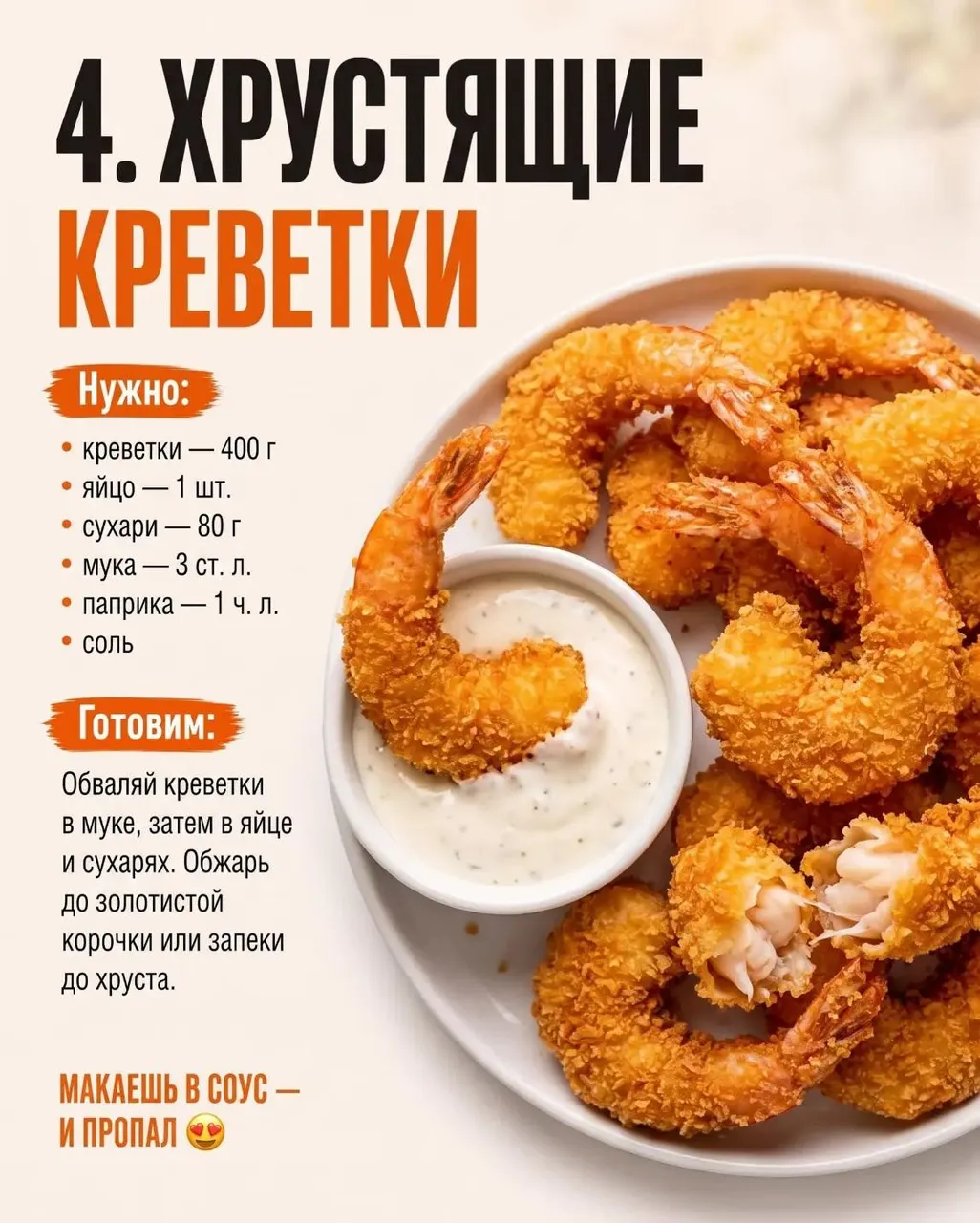
- 175–180 °C — most foods: battered vegetables, onion rings, cheese sticks, shrimp.
- 185–190 °C — second fry for chips, small quick items.
Small batches
Each batch of cold food lowers the oil temperature by 20–40 °C. Add too much and the oil drops to 130–140 °C, and you get a soft, greasy crust instead of a crisp one.
Lower in a few pieces at a time so they float freely. Between batches let the oil recover its temperature — 1–2 minutes.
Food should be dry and not icy. Water in hot oil boils instantly and spatters oil. Don't thaw frozen products, but shake off the ice.
Three-step breading
The classic sequence is flour → egg → crumbs. Flour dries the surface so the egg sticks, the egg acts as glue, the crumbs give crunch.
- Line up three bowls: seasoned flour, egg beaten with 1 tbsp water or milk, breadcrumbs.
- Keep one hand "dry" (flour and crumbs) and one "wet" (egg). That way your fingers don't end up clubbed in breading.
- For a double coat (extra crisp and sturdy), repeat the egg and crumbs.
- Leave breaded food on a rack for 10–15 minutes: the coating sets and won't fall off in the oil.
After the oil: a rack, not paper
When food comes out of the oil, steam keeps escaping for several minutes. On kitchen paper that steam condenses underneath and the crust goes soggy.
Better to drain fried food on a rack set over a tray: air flows all round and the crust stays crisp. If you use paper, turn the food after a minute.
Salt immediately, while the surface still glistens with oil, so the salt sticks. Keep finished batches warm on a rack in a 90–100 °C oven while you fry the rest.
Safety
Hot oil is one of the most common causes of kitchen burns and fires. A few rules never to break.
- Never leave oil on the heat unattended.
- Use a deep, heavy pan with the handle turned in. Keep children and pets away.
- Lower food in away from you, gently, with a slotted spoon or tongs — don't drop it.
- If the oil starts smoking, take it off the heat at once: the next stage is fire.
- If the oil catches fire: turn off the heat and cover the pan with a lid or baking tray, and don't lift it until completely cool. You can also smother it with plenty of baking soda.
- Never pour water on burning oil: the water flashes to steam and throws the burning oil out as a fireball.
How many times can oil be reused
Oil can be reused if stored properly. After frying, let it cool completely, strain it through a fine sieve lined with paper or muslin and keep it in a sealed bottle somewhere cool and dark.
- After potatoes and vegetables — 4–6 times.
- After breaded or battered food — 2–3 times: crumbs burn and degrade the oil.
- After fish — 1–2 times, and only for fish: the smell carries over.
- Throw the oil away if it has darkened, thickened, smells off, foams heavily or smokes at normal temperatures.
The air fryer: an alternative
An air fryer is a small, powerful convection oven. Hot air blows over the food from all sides, drying and browning the surface almost like deep-frying — with 1 tbsp oil instead of a litre.
It does best with chips and wedges, wings, nuggets and breaded foods, vegetables and reheating frozen items. Wet batter doesn't work — it just drips off.
The rules: don't overfill the basket — one layer; spray the food with oil; shake the basket every 5 minutes; 180–200 °C. Times are usually 20–30% shorter than in an oven.
Questions and answers
Why does the breading fall off?+
The food was wet, the flour step was skipped, or it went straight into the oil. Dry the food, bread it flour–egg–crumbs and let it rest 10–15 minutes.
Why is it burnt outside and raw inside?+
The oil is too hot for pieces that size. Fry large pieces at 160–170 °C, or brown them and finish in a 180 °C oven.
Can I deep-fry in a frying pan?+
Yes, in a deep frying pan or sauté pan with 2–3 cm of oil, turning the food. That's shallow-frying — fine for patties, schnitzels, syrniki and pirozhki.
How do I get rid of the fried smell in the kitchen?+
Turn the extractor on before you start frying, not after. Afterwards, simmer a pan of water with vinegar or citrus peel for 10 minutes.
How much oil do chips absorb?+
At the right temperature, about 5–8% of their weight. In oil that's too cool, up to 15–20%. A thermometer literally saves calories.
Try it in practice

More kitchen secrets
Sushi and rolls at home: restaurant-style rice, fillings and safe fish
Which rice to use and how to rinse it, the water ratio and seasoned vinegar, how to cool rice properly. How to roll maki and inside-out rolls that don't fall apart, which fish is safe raw, fillings without raw fish, baked rolls and storage.
Read the articleHow to assemble a cake at home: level layers, soaking syrup, smooth sides and drips
How to cut a sponge into even layers, how much soaking syrup each layer needs, why to pipe a dam and do a crumb coat, how to smooth a cake with a scraper, how much frosting a 20 cm cake needs, how to make chocolate drips, stack a tall cake and transport it in one piece.
Read the articleHomemade ice cream without a machine: rich vanilla, sorbet and banana ice cream
Two-ingredient ice cream with condensed milk, a classic custard-based vanilla, why ice crystals form and how to prevent them, sorbet with the right amount of sugar, frozen-banana ice cream, ice lollies and storage tips.
Read the article