Wok cooking and Asian sauces: restaurant-style stir-fry and sauces without jars
Why home stir-fries stew instead of fry, and how to fix it. Velveting for tender chicken, the order to add ingredients, fried rice from yesterday's rice. Ratios for teriyaki, an all-purpose stir-fry sauce, peanut, sweet-and-sour and noodle sauce — and balancing the five tastes.
Why home stir-fries stew
In a restaurant the wok sits over a burner 5–10 times more powerful than a domestic one. Food sears instantly, moisture evaporates and the dish picks up a special smoky aroma — wok hei, the "breath of the wok". At home, especially if everything goes in at once, the pan cools, the food releases juice and you get stewing instead of frying.
The fix is to work with what you have: maximum heat, small batches, everything prepped in advance. On an electric or induction hob, a wide heavy frying pan often works better than a wok — it has more contact with the heat.
Everything ready before the heat goes on
A stir-fry cooks in 5–8 minutes, and there's no time to chop anything along the way. Prepare everything first: chop, mix the sauce, lay things out in bowls in the order they go in. Cooks call it mise en place.
- Cut everything evenly and thinly: meat in 5 mm strips across the grain, vegetables in matchsticks, thin slices or small pieces.
- Meat is easier to slice thinly after 20–30 minutes in the freezer.
- Dry the vegetables after washing: water on hot oil spits and cools the wok.
- Mix the sauce in advance in a cup, starch included.
Velveting: tender chicken, Chinese-restaurant style
Why is chicken in a Chinese restaurant so tender and juicy, even breast? It's velveting — marinating in starch. The starch forms a thin protective coat that holds in juice over high heat.
- Per 500 g sliced chicken breast: 1 tbsp cornflour, 1 tbsp soy sauce, 1 egg white (or 1 tbsp water), 1 tsp oil.
- Mix and leave for 20–30 minutes.
- For beef: ½ tsp baking soda per 500 g sliced meat for 15 minutes, then rinse and dry. The soda softens the fibres, and even cheap beef turns tender.
The order of cooking
Use an oil with a high smoke point: refined sunflower, peanut, rapeseed. Olive oil and butter will burn. Heat the wok until it just smokes, then add 1–2 tbsp oil and swirl it round the sides.
- Meat or seafood — in small batches in a single layer. Let a crust form for 1 minute, then toss for 2–3 minutes. Remove to a plate.
- Aromatics — garlic, ginger, the white part of spring onions, chilli — 20–30 seconds until fragrant, no longer.
- Hard vegetables — carrot, broccoli, pepper — 2–3 minutes.
- Soft vegetables — courgette, green beans, mushrooms, cabbage — 1–2 minutes.
- Return the meat, pour in the sauce and toss for 30–60 seconds until it thickens and turns glossy.
- Take off the heat and add herbs, sesame seeds and the green part of the spring onions.
Balancing the five tastes
Asian cooking is built on balance: salty, sweet, sour, hot and umami. If a sauce seems off, check which taste is missing.
- Salty and umami: soy sauce, fish sauce, oyster sauce, miso.
- Sweet: sugar, honey, mirin, brown sugar, hoisin.
- Sour: rice vinegar, lime juice, tamarind.
- Hot: fresh chilli, chilli flakes, sriracha, sambal, ginger.
- Aroma: sesame oil (only at the end — heat makes it bitter), garlic, spring onion, coriander.
Five sauces by ratio
All amounts are for 2–3 servings. Mix in advance and stir the starch back in just before pouring.
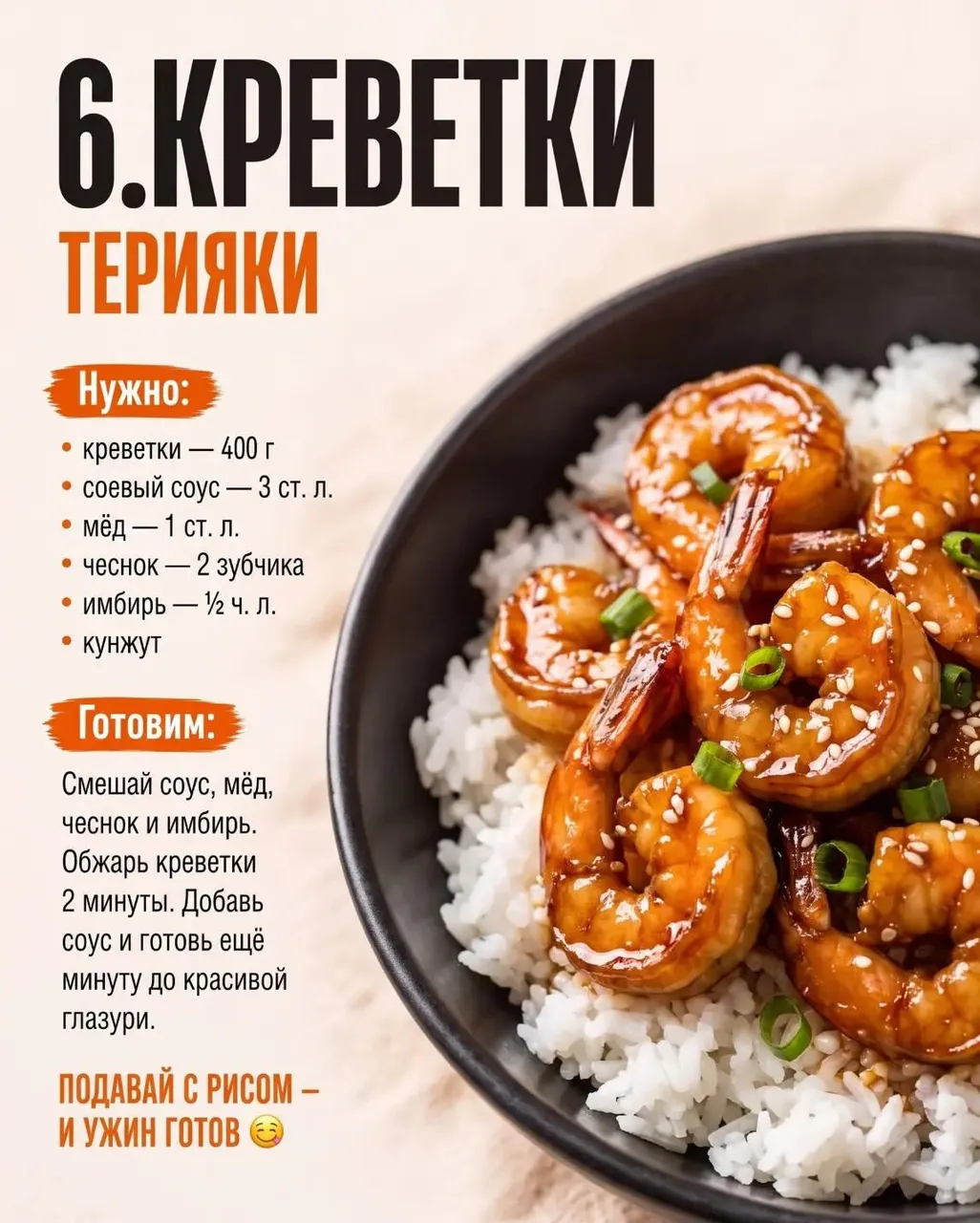
- Teriyaki: 4 tbsp soy sauce, 4 tbsp mirin (or 2 tbsp sugar + 2 tbsp water), 2 tbsp sake or dry white wine, 1 tbsp sugar or honey. Reduce until thick or thicken with 1 tsp starch.
- All-purpose stir-fry: 3 tbsp soy sauce, 1 tbsp oyster sauce, 1 tbsp rice vinegar, 1 tbsp sugar or honey, 1 tsp sesame oil, 1 tsp cornflour, 60 ml water.
- Peanut: 3 tbsp peanut butter, 2 tbsp soy sauce, juice of ½ lime, 1 tbsp honey, 1 garlic clove, warm water to the right consistency. For noodles, spring rolls and salads.
- Sweet and sour: 3 tbsp ketchup, 3 tbsp rice vinegar, 3 tbsp sugar, 1 tbsp soy sauce, 100 ml pineapple juice or water, 1 tsp cornflour.
- Noodle and dipping sauce: 3 tbsp soy sauce, 1 tbsp rice vinegar, 1 tsp sugar, 1 tsp sesame oil, garlic, chilli, spring onion.
Fried rice
Fried rice is made from yesterday's rice. Freshly cooked rice is moist and soft: in the pan it clumps and turns to mush. Rice chilled overnight in the fridge dries out, and the grains firm up and separate.
For 2 servings: 400 g cold cooked rice, 2 eggs, 150 g vegetables (peas, carrot, sweetcorn), 2 spring onions, 2 tbsp soy sauce, 1 tsp sesame oil. Beat the eggs and scramble them quickly in the hot wok, then remove. Fry the vegetables for 2 minutes, add the rice, breaking up lumps, and fry for 3–4 minutes without stirring constantly — the rice should brown slightly. Add the sauce, eggs and spring onions.
Noodles: which to use and how
Wheat noodles (egg, udon, ramen) are for frying and soups. Rice noodles are for pad thai and Vietnamese dishes and are often soaked in hot water for 5–10 minutes rather than boiled. Buckwheat soba is for cold dishes and soups.
Cook noodles a minute less than the pack says — they finish in the wok. Rinse under cold water after cooking and toss with a drop of oil so they don't stick. Add them to the wok last, with the sauce, and toss with tongs for 1–2 minutes.
Looking after a wok
A carbon-steel wok needs seasoning before first use: wash it with detergent to remove the factory coating, dry it over the heat, then heat it hot and wipe on a thin layer of oil with kitchen paper. Repeat 3–4 times — a non-stick layer forms on the surface.
After cooking, wash the wok with hot water and a soft brush, no harsh detergents, dry it over the heat and wipe with a drop of oil. The seasoning improves with every use and the wok darkens. That's normal.
Questions and answers
What can replace mirin?+
Dry white wine with sugar (1 tbsp wine and ½ tsp sugar per 1 tbsp mirin), or simply water with sugar in the same proportion.
What can replace oyster sauce?+
Soy sauce with a pinch of sugar, hoisin, or vegetarian mushroom "oyster" sauce. The flavour will be a little different, but the balance holds.
Why is my stir-fry sauce runny?+
Not enough starch, or the sauce went into a wok that wasn't hot enough. Add 1 tsp starch mixed with 1 tbsp water and heat for 30 seconds on high.
Can I stir-fry frozen vegetables?+
Yes, straight from frozen. But fry them separately over very high heat in small batches so the water evaporates quickly, and only then combine them with everything else.
Do I need a non-stick wok?+
Non-stick coatings don't like the high heat a stir-fry needs. Carbon steel or cast iron is better. If your wok is coated, don't heat it empty until it smokes.
Try it in practice
More kitchen secrets
Sushi and rolls at home: restaurant-style rice, fillings and safe fish
Which rice to use and how to rinse it, the water ratio and seasoned vinegar, how to cool rice properly. How to roll maki and inside-out rolls that don't fall apart, which fish is safe raw, fillings without raw fish, baked rolls and storage.
Read the articleHow to assemble a cake at home: level layers, soaking syrup, smooth sides and drips
How to cut a sponge into even layers, how much soaking syrup each layer needs, why to pipe a dam and do a crumb coat, how to smooth a cake with a scraper, how much frosting a 20 cm cake needs, how to make chocolate drips, stack a tall cake and transport it in one piece.
Read the articleHomemade ice cream without a machine: rich vanilla, sorbet and banana ice cream
Two-ingredient ice cream with condensed milk, a classic custard-based vanilla, why ice crystals form and how to prevent them, sorbet with the right amount of sugar, frozen-banana ice cream, ice lollies and storage tips.
Read the article